


The term high-risk pregnancy suggests that this must refer to a problematic pregnancy. Contrary to this sweeping assumption, a high-risk pregnancy is simply a pregnancy that requires closer care. In such cases, mothers-to-be benefit from more intensive monitoring and medical care during the pregnancy and birth.
What is a high-risk pregnancy?
Around 30 to 40% of all pregnancies in Switzerland are classified as high-risk pregnancies by doctors. The vast majority of high-risk pregnancies unfold completely normally.
By definition, high-risk pregnancies are pregnancies that can be dangerous for the mother or child. However, a high-risk pregnancy does not necessarily mean that complications will occur or that there is an acute risk for the mother and/or child.
Pregnancies where the mother has a pre-existing condition and pregnancies at an older maternal age (advanced maternal age pregnancies) statistically lead to more miscarriages. Such pregnancies are considered to be more risky and are monitored more closely as high-risk pregnancies.
Early classification as a high-risk pregnancy enables doctors to detect any complications quickly and to take appropriate measures.

When do we call a pregnancy a high-risk pregnancy?
We use the term high-risk pregnancy when certain factors increase the probability of complications during the pregnancy. These factors include, for example, the mother being under 18 or over 35 years of age, pre-existing conditions such as diabetes or high blood pressure, multiple pregnancies or previous pregnancy complications. Any anomalies in the baby or during the course of the pregnancy can also lead to a doctor classifying the pregnancy as a high-risk pregnancy.
Thanks to ever-improving ultrasound images and more precise laboratory diagnostics, a lot of risks can be identified at an early stage. However, advances in medicine in recent years have also meant that a pregnancy is more likely to be documented as a high-risk pregnancy by the attending doctors. This can understandably lead to uncertainty and anxiety for those affected.
We want to raise awareness that classification as a high-risk pregnancy on the basis of certain risk factors is not uncommon and, in terms of care, brings nothing but benefits for mothers-to-be and children.
Risk factors and possible signs of a high-risk pregnancy
- The mother is over 35 years of age and/or the father is over 45 of age
- Previous miscarriages or premature births
- Complications during previous pregnancies and births
- Rubella infection or toxoplasmosis during the pregnancy
- Taking certain medication during pregnancy
- X-ray exposure during the pregnancy
- Positive results in the general preparatory examinations
- Multiple pregnancy
- Diabetes
- Obesity
- Hepatitis
- HIV
- Asthma
- Thyroid disorders
- High blood pressure
- Cardiovascular disease
- Illnesses affecting other maternal organs
- Previous caesarean section
- Breech position
- Hereditary diseases in the mother's and/or father’s family
- Intrauterine growth restriction
- Premature rupture of membranes, premature contractions, cervical insufficiency
- Vaginal bleeding (placenta previa, low-lying placenta, premature partial placental abruption)
- Endometriosis
Endometriosis and high-risk pregnancy
In principle, endometriosis and the wish for children are not mutually exclusive. However, the illness can have an impact on fertility. In addition, the risk of ectopic pregnancy, miscarriage, bleeding, tears in the uterus and other complications is increased in women with endometriosis. Keeping all scheduled pre-natal care appointments with the attending doctor is therefore very important.
Despite the increased risks, a normal pregnancy is the norm for women with endometriosis. Therefore, close care tailored to the mother's individual needs is essential.
High-risk pregnancy: what do I need to know?
Nutrition
Eat a balanced diet. To reduce the risk of infection, avoid raw milk products, raw meat or meat that has not been fully cooked, and other raw animal-based foods.
Exercise and sport
If possible, continue to exercise regularly. However, avoid extreme physical exertion and sports that involve a high risk of injury or falling.
Alcohol and smoking
Avoid drinking alcohol and smoking altogether throughout your pregnancy. Also avoid second-hand smoke.
Temperature
Avoid excessive heat and very high temperatures, for example, avoid saunas, hot whirlpools and very hot baths.
X-rays
Avoid unnecessary X-ray examinations and always inform healthcare professionals about your pregnancy. If an examination is medically necessary, appropriate protective measures can be taken.
Employer
Your employer must assess your workplace and offer protective measures or, if necessary, equivalent alternative work.
Sick leave
If you are fully or partially unable to work for health reasons, your doctor may put you on sick leave; this may also entail partial sick leave.
Employment ban
In the case of hazardous or arduous work or if protective measures are not sufficient, the attending doctor may issue an employment ban.
Salary during an employment ban
If there is no suitable replacement work available, employees are generally entitled to 80% of their previous salary.
Mental health
Look after your mental health and take your fears, worries and heavy emotional strain seriously. Talk to your doctor about this and get support if you need it.
Examinations
In individual cases, special examination methods can be employed to determine whether your unborn child has any genetic diseases. However, it is essential that parents carefully consider the benefits and risks of such procedures.
Are you looking for general tips and tricks for easing discomfort during your pregnancy? We’ll show you how to combat nausea and tired legs, which types of exercise are suitable despite your growing belly, and much more.
You can find our tips and tricks during pregnancy here.
Advanced maternal age pregnancy
The reasons for a late pregnancy differ from woman to woman. Nowadays, it is not uncommon for women to only start thinking about having children after the age of 30. The probability of becoming pregnant decreases with each passing year, and from the age of 35 onwards, we speak of a so-called high-risk pregnancy.
The risk of a miscarriage or a changed number of chromosomes (e.g. trisomy 21) rises statistically for older pregnant women (slightly higher risk from the age of 30, much higher risk from the age of 40).
How likely am I to fall pregnant after the age of 35?
The biological clock is a fact of life. Statistically speaking, the probability of falling pregnant declines with every year.
However, the reasons for the decline in fertility as women grow older differ considerably.
Women are born with a limited number of eggs. From their mid-30s, the number and quality of their eggs drop sharply. The eggs of older women can also not be inseminated as easily as those of younger women. On top of this, the menstrual cycle becomes less regular with age.
According to experts, women who decide to have their first child after the age of 30 often have to wait longer for a positive pregnancy test. The chance of falling pregnant at age 40 is only half of what it is at age 35.
Women over the age of 35 are less likely to fall pregnant naturally as they get older. If, despite regular unprotected sexual intercourse, you are not pregnant after six months, medical clarification is recommended.
A fertility test can measure a woman’s fertility. It consists of a hormone analysis and an ultrasound examination. However, this test is not 100% reliable, as many factors can affect fertility.
What risks may arise?
Pregnancy at an advanced age, also called advanced maternal age pregnancy, is possible, but it also involves several risks.
- The probability of gestational diabetes is higher: strict control of blood sugar through diet and exercise is essential. Sometimes medication is also required. If not treated, gestational diabetes can cause the baby to grow much bigger, which increases the risk of birth-related injuries. Gestational diabetes can also increase the risk of premature birth, high blood pressure during pregnancy and complications for the child after it is born.
- High blood pressure: Research clearly indicates that the risk of developing high blood pressure during pregnancy is considerably greater for older women than for younger ones. Your doctor should carefully monitor your blood pressure and the baby’s development.
Women affected should go for check-ups more often. In addition, the birth may be induced before the scheduled due date in order to avoid complications.
- Risk of certain chromosomal disorders increases: children of older mothers have a higher risk of certain chromosomal disorders, such as trisomy 21.
- The risk of a miscarriage is higher: the risk of losing the pregnancy – through a miscarriage or a stillbirth – increases for older women due to pre-existing conditions or foetal chromosomal abnormalities. Research results indicate that the declining egg quality combined with a higher risk of chronic illnesses such as high blood pressure and diabetes can increase the risk of a miscarriage.
Does the age of the father also play a role?
In contrast to women, men can father a child until a very advanced age as they can constantly produce new sperm.
The sperm-producing stem cells of a 50-year old man have divided around 600 times. The stem cells grow older and the risk increases for mutations and specific defects in the genetic material that can lead to many illnesses. This is why men over the age of 40 are not permitted to become sperm donors in the majority of countries.
A study published in 2018 by the Stanford University School of Medicine analysed data from over 40 million births and found that children of older fathers (35+) have a statistically higher risk of premature births, low birth weight, ventilation immediately after birth and seizures.
In addition, the study found that the partners of men aged 45 and over had a 28% higher risk of developing gestational diabetes than the partners of fathers aged 25 to 34.
In this section, we have put together some information for fathers-to-be that will guide them through their partner’s pregnancy, the birth and day-to-day life: Tips for fathers-to-be.
What can mothers do to ensure a successful pregnancy at an advanced age?
Experts believe that older pregnant women should pay more attention to their own health and that of their unborn child. A balanced diet and regular physical activity can have a positive effect on the course of the pregnancy. The mother should also go for regular check-ups. Parents-to-be can enquire about prenatal tests to identify chromosomal abnormalities at an early stage.
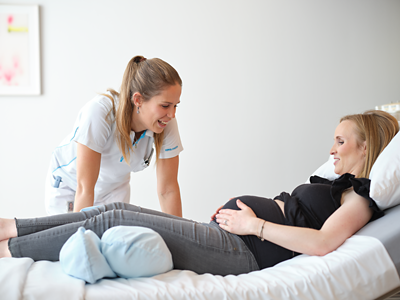

Examinations during a high-risk pregnancy
Check-ups help to identify risks for mother and child quickly and to decide on appropriate further measures. If the pregnancy is uncomplicated, a total of seven pre-natal check-ups are planned. In high-risk pregnancies, additional check-ups are required.
Depending on the individual situation, additional examinations may be necessary.
Detailed ultrasound (anomaly scan)
A basic ultrasound scan checks that the baby’s development is appropriate for their age. In a detailed ultrasound examination, the baby's head, brain ventricles, and cerebellum are examined in more detail and the ratio of the size of the heart to the ribcage is measured. In addition, the position and size of the heart chambers are checked, and it is checked whether the spine and abdominal wall are closed and the bladder and stomach are visible.
First trimester screening (FTS)
This is a screening test in the first trimester that can detect an increased risk of a trisomy.
Non-invasive prenatal testing (NIPT)
A non-invasive prenatal test (NIPT) can be used to examine the child’s genetic material (DNA) from the placenta. To carry out the test, blood is taken from the a vein in the pregnant woman's arm. From the 10th week onwards, her blood contains enough of the child’s genetic material to make an examination possible. Only individual genetic changes can be investigated with an NIPT.
Doppler ultrasound
A Doppler ultrasound is an examination that can be used to measure blood flow in the blood vessels of the unborn child, the mother and the placenta. It provides important information about the baby’s blood supply and can give an indication of how well the placenta is working and whether the unborn child is receiving enough oxygen and nutrients.
Cardiotocography (CTG)
Cardiotocography is a technique for tracking and recording the heart rate of the unborn child and the contractions of the mother-to-be simultaneously. It is used both as part of pre-natal care and during childbirth.
Amniotic fluid test (amniocentesis)
This prenatal test can detect chromosomal disorders in unborn children. For this test, amniotic fluid is taken from the mother-to-be between the 14th and 18th week of pregnancy. The baby's cells in this fluid provide information on whether they have any chromosomal disorders.
Which examinations are recommended depends on the personal risk factors and the course of the pregnancy.
You can find more information about the individual examinations on our page on regular pregnancy check-ups.
Our high-risk pregnancy specialists
Our high-risk pregnancy specialists will provide you with empathetic and personalised support throughout your pregnancy. They have a wide range of professional specialisations and look after pregnancies with specific risks, such as gestational diabetes or pre-existing conditions. Multilingual gynaecologists are on hand to assist you if required.




Our maternity clinics





FAQ: Frequently asked questions about high-risk pregnancy
What happens in the event of a high-risk pregnancy?
In a high-risk pregnancy, the doctors will provide more intensive and regular care. Depending on the individual risk, additional ultrasound examinations, blood tests or other check-ups may be useful.
Reasons for high-risk pregnancy: what are the possible reasons?
There can be several different reasons for a high-risk pregnancy, including the advanced age of the pregnant woman, pre-existing conditions such as diabetes or high blood pressure, a multiple pregnancy, previous complications or problems in the current pregnancy.
Can you give birth naturally in a high-risk pregnancy?
Yes, a natural birth is often possible even in high-risk pregnancies. Whether a vaginal birth is an option depends on the individual risk factors and the course of the pregnancy. Your gynaecologist and midwife will discuss the right type of delivery for you and your baby.
What warning signs and complications can occur during pregnancy?
Possible warning signs include bleeding, premature contractions or premature rupture of membranes. High blood pressure, gestational diabetes or abnormalities in your baby can also occur. If you have any symptoms, you should contact your gynaecologist as soon as possible.