


A colonoscopy is the most preventative examination for the early detection of colon cancer. It is recommended at regular intervals from the age of 50, as well as for younger people who have an increased risk of bowel cancer.

Colonoscopy overview
A colonoscopy is an examination primarily used to detect pathological processes in the intestine. Among other things, the examination serves to clarify and diagnose illnesses in the large intestine and rectum. These include intestinal bleeding, inflammation such as ulcerative colitis, diverticulosis (or diverticulitis), intestinal polyps and cancer (colon cancer, rectal cancer, anal cancer). The anus, rectum, large intestine and part of the small intestine are examined.
With the help of regular colonoscopies, colon cancer can be detected with almost 100 percent certainty. Since colonoscopies can detect colon cancer at an early stage, the chances of recovery for patients are very good, especially in such cases.
If gastroenterologists find small polyps during the examination, they can remove these abnormalities as part of the colonoscopy. This is an important measure for colon cancer prevention, as almost all intestinal tumours develop from polyps (adenomas). The earlier these are removed, the greater the patient’s chances of recovery.
Treatment goal
With a colonoscopy, the medical examination method aims for the early detection and diagnosis of bowel diseases, such as colon cancer.
A colonoscopy allows for a reliable assessment of the intestine. In addition, the removal of polyps during a colonoscopy is a proven treatment method with extremely low complication rates that is well tolerated by patients.
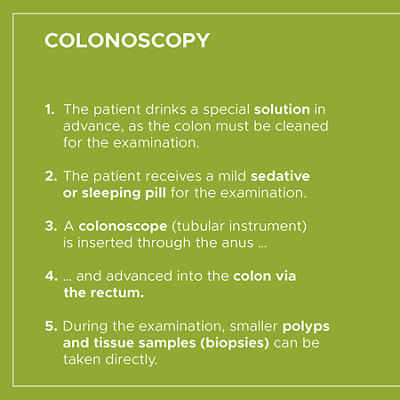

Colonoscopy procedure
Early detection and removal of intestinal polyps is crucial, as these benign growths that develop in the mucosa of the large intestine can also turn into malignant tumours over time. What makes polyps particularly insidious is the fact that they do not initially cause any discomfort, which is why they must first be identified with the help of a minimally invasive colonoscopy.
As a first step, your documentation will be examined, you will be given special clothing for the colonoscopy and an IV will be inserted, through which a sedative will later be administered. Afterwards, you will be brought to the examination room with the help of a stretcher, where you will be received by the team responsible for the examination.
The attending doctor will talk to you and answer any final questions before you are given the sedative. Once you are asleep, the gastroenterologist will first manually examine your rectum. Often, the rectum and anal canal are then assessed for abnormalities with a proctoscope.
The examination of the intestine is usually carried out on an outpatient basis using a colonoscope, which is an endoscope for intestinal examinations. It is a centimetre-wide, flexible tube consisting of a light source, a camera that transmits images from the inside of the intestine to a monitor, and a channel for surgical instruments such as forceps or loops. In addition, devices are attached to the tube, which allows, among other things, for fluid and gas in the intestine to be siphoned.
For the examination, you will lie in a relaxed position on your side. The gastroenterologist inserts the colonoscope through the anus into the rectum and carefully moves the examination device to the end of the small intestine. Finally, as the endoscope is withdrawn, the intestine is examined from the inside for abnormalities, tissue changes and intestinal polyps. The intestine is repeatedly inflated with air to expand it and improve visibility.
Tissue samples are taken from suspicious areas in the intestine, which can then be examined using the high-resolution images. For 30–40% of all people over 50 who undergo a colonoscopy, several polyps (adenomas) are found. These can be removed directly during the examination with tiny pliers and a loop, with or without high-frequency current.
Since the mucous membrane in the intestine does not contain any painful nerve receptors, a colonoscopy is largely painless. However, expanding the intestine with air is sometimes considered uncomfortable.
The actual examination usually takes about 30 minutes. The examination only takes up to 60 minutes if several polyps have to be removed at once or if the intestine is highly twisted.
Colonoscopy: preparation and precautions
Certain foods, such as whole grains, high-fibre foods or small seeds, should be avoided in the days leading up to the colonoscopy, as they can block the colonoscope’s channels and thus obstruct visibility. Additionally, certain blood-thinning medications should be discontinued in consultation with your doctor before the colonoscopy. You should also stop taking iron supplements five days before the colonoscopy.
In the evening before and in the morning of the examination day, you must drink a strong laxative with plenty of fluid so that the bowels are emptied before the colonoscopy. The attending doctor will provide you with detailed information about this measure before the examination. Immediately before the colonoscopy, you will also be given a light sedative or tranquilliser.

Aftercare and recovery
After the colonoscopy, patients are monitored until the tranquilliser or sedative has worn off. You can then discuss the examination results with your doctor. For tissue sampling, it may take a few days for the definitive test result to be available.
Please note: if you have been given a sedative or a tranquilliser, you must not drive immediately after the examination. You should therefore decide beforehand how you will get home after the colonoscopy.
Colonoscopy: risks and potential complications
A colonoscopy is generally low-risk. However, the increase in air in the intestines can lead to temporary flatulence, a feeling of pressure in the abdomen and abdominal pain or cramp-like symptoms. Occasionally, minor mucosal injuries and bleeding may occur.
Serious complications, such as injuries to the intestinal wall, are extremely rare and usually affect older patients with concomitant diseases. In addition, these complications often occur in connection with a polyp removal.
Your breathing or heart can be temporarily impaired by sedatives or tranquillisers. Any bleeding that occurs can usually be stopped quickly using the colonoscope. Delayed bleeding may also occur a few days after the minimally invasive intervention, but this is rare.
A rupture of the intestinal wall occurs in less than one in 1,000 people examined and occurs very rarely in a healthy intestine. If surgery on the colon or nearby organs has been performed before the colonoscopy, complications occur in about one in 300 people.
Patients can trust that they will be cared for at all times by experienced gastroenterologists who will act professionally, prudently and quickly in the unlikely event of such a complication.
FAQ
At what age should a colonoscopy be performed?
As a general rule, the Swiss Cancer League recommends that anyone over the age of 50 have a colonoscopy. For the early detection of bowel cancer, however, younger people in at-risk groups should also consider having a colonoscopy.
How frequently should a colonoscopy be carried out?
If no abnormalities are found during the colonoscopy, or at most one or two harmless, small polyps, the colonoscopy should be repeated after ten years. If, on the other hand, larger, advanced polyps are found or if there is a family history, colonoscopies are recommended every three to five years. If symptoms arise between colonoscopies, it may be advisable to move the colonoscopy forward.
Who covers the costs of a colonoscopy in Switzerland?
Basic health insurance pays for a colonoscopy every 10 years for individuals between the ages of 50 and 69. If a diagnostic colonoscopy is necessary to clarify symptoms, basic health insurance will always cover the cost (less deductible and coinsurance). Compared to a preventive colonoscopy, a diagnostic colonoscopy is slightly more expensive.
Centres 4
-
Bowel Cancer Centre Klinik St. Anna
Available by telephone from Monday to Friday 09.00 - 11.30 h and 13.30 - 16.00 h
-
Tumour Centre Klinik St. Anna
Monday to Friday 08.00 - 17.00 h
