


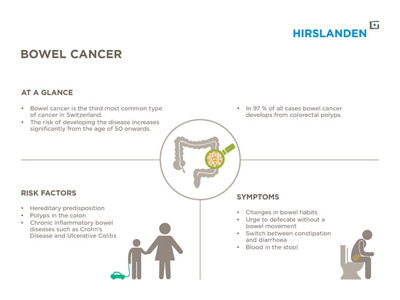
The term ‘colorectal carcinoma’ covers cancers of the colon and rectum. Bowel cancer is the third most common type of cancer, mainly affecting people over the age of 50. In recent years in particular, however, an increasing number of younger people have contracted it. If bowel cancer has developed, surgery, chemotherapy and radiotherapy are used for treatment.

Overview of bowel cancer
More than 4,000 people in Switzerland develop bowel cancer every year, with men and women affected at roughly the same rate. Bowel cancer is one of the most common types of tumour, but it is easy to treat if diagnosed early.
From the age of 50, the risk of illness increases significantly. For this reason, the charity Krebsliga recommends regular colonoscopies from this age onwards as an early detection measure.
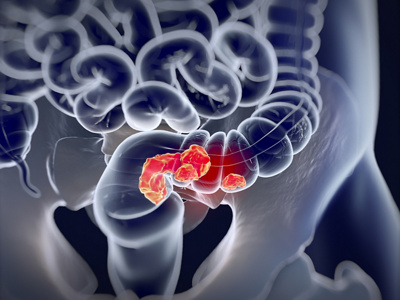
In most cases, when bowel cancer is diagnosed it actually means cancer of the large intestine, also called the colon (colon cancer), or cancer of the rectum (rectal cancer). The medical term for bowel cancer is therefore colorectal carcinoma. The small intestine is rarely affected by cancer. In fact, 60 to 70 % of all intestinal tumours occur in the last 30 centimetres or so of the organ, usually on the left side.
Colon cancer mainly develops from intestinal polyps, which can turn malignant. Most of these polyps are adenomas, which are benign, glandular growths. Around one-fifth of such adenomas develop over time into bowel cancer.
If bowel cancer is diagnosed, the chances of recovery and type of treatment depend on several factors. Some of these factors are:
● Cancer stage: What stage is the cancer?
● Lymph nodes: Are lymph nodes affected?
● Metastases: Are metastases present?
Bowel cancer can metastasise via the bloodstream, particularly into the lungs and liver, and via lymphatic vessels into nearby lymph nodes. The cancer can also spread directly to the peritoneum.
Overview of the stages of bowel cancer
Bowel cancer is classified into stages, from a preliminary stage (stage 0) to stage 4. Bowel tumours are rarely detected at stage 1, because at that stage they are usually symptom-free. They are often diagnosed at stage 2 or 3.
The stage of the tumour plays a decisive role in the diagnosis of bowel cancer. It is essential for assessing the chances of recovery and for choosing a suitable treatment, as it describes how far the cancer has already spread in the body.
Bowel cancer stages 0 to 4
- Stage 0: At this stage, a preliminary stage, the bowel cancer is confined to the uppermost cell layer.
- Stage 1: The tumour is restricted to the intestinal mucosa or wall. The lymph nodes are not yet affected.
- Stage 2: The cancer has continued to grow into the mucous membrane of the intestine and has affected all layers of the intestinal wall. Lymph nodes are not yet affected.
- Stage 3: The tumour has spread to nearby lymph nodes.
- Stage 4: In the fourth stage, distant metastases have occurred, for example in the lungs or liver.
Causes of bowel cancer
The development of bowel cancer can be facilitated by a number of risk factors. There are various factors that can increase the probability of bowel cancer occurring. As a general rule, this increase is particularly sharp when several factors interact.
A distinction can be made between factors that cannot be influenced and those that can be influenced.
Factors that cannot be influenced in the development of bowel cancer include:
- Age
- Environmental factors
- Genes (family history of bowel cancer)
- Intestinal polyps
- Crohn’s disease or ulcerative colitis, which are amongst the inflammatory bowel diseases.
The factors that can be influenced in the development of bowel cancer include:
- Lack of exercise
- Smoking
- Alcohol consumption (moderate to high = two or more alcoholic beverages per day, or more than 60 grams of alcohol per week)
- Being overweight, especially with a lot of abdominal fat
- Daily consumption of red meat
- Insufficient intake of dietary fibre (e.g. from fruits, vegetables, cereals and pulses)
Age plays a particularly decisive role in the development of bowel cancer: the risk of illness increases sharply from the age of 50. However, it should be noted that symptoms in young people should also be investigated thoroughly.
In the US, bowel cancer has been appearing more frequently in young people under the age of 50 since the 1990s. This development is becoming increasingly clear in Switzerland as well: more and more young people are suffering from intestinal tumours. Since many young patients cannot imagine that they might have bowel cancer, which has been associated with old age for years, they shy away from going to the doctor. This is a serious mistake that can result in patients not receiving treatment at an early stage, which would increase their chances of recovery.
If adenomas appear before the age of 50, special care should be taken. In these cases, the risk of bowel cancer is significantly increased, not only for those affected, but also for their siblings and parents. The situation is different for adenomas that appear after the age of 60: these have no direct impact on the health of relatives.
Important: If other cancers, such as stomach cancer or cervical cancer, occur in the family, the affected person should inform their attending doctor.
Bowel cancer symptoms
Bowel cancer can present with the following symptoms:
- Changes in bowel habits
- Urge to defecate without actually doing so
- Alternating between constipation and diarrhoea
- Mucus or blood in or on the stool
- Pencil-thin stools
- Black stools
- Nausea
- Lack of appetite
- Feeling of fullness
- Recurring digestive discomfort and abdominal pain
- Weight loss despite maintaining the same calorie intake and activity levels
- Fever without signs of a cold
- Anaemia, which manifests itself as tiredness, decreased performance and pale skin.
Less commonly, the following symptoms may occur:
- Persistent itching in the anal area, if the tumour occurs near the anus or if the mucous membrane is irritated.
- Recurring mouth ulcers (aphthae). An accumulation of recurring mouth ulcers occurs particularly in advanced bowel cancer when the immune system is weakened, or when tumour therapy has been initiated.
Better safe than sorry: of course, anyone can experience digestive problems at some point. However, if they continue for a while or come back, you should always consult a doctor. Acting quickly, finding a polyp or finding a tumour can be life-saving.
NB: It is worth taking a look at your stool after each bowel movement. This will mean you will notice any bleeding or mucus earlier and take appropriate measures.
Diagnosis of bowel cancer
Diagnosis of bowel cancer requires a colonoscopy to be carried out. As part of the colonoscopy, tissue samples are taken if there are any suspicious changes, and they are then examined.
Both a colonoscopy and a blood-in-stool test are used in Switzerland as methods for the early detection of bowel cancer. Although both techniques have been scientifically tested, there are good arguments in favour of a colonoscopy with regard to possible polyps.
Although a stool test is simpler to perform, it should be borne in mind that blood does not necessarily appear in the stool in the early stages. On the other hand, a colonoscopy is more time-consuming. The great advantage of a colonoscopy is that, in the vast majority of cases, any polyps discovered during the procedure can be removed straight away.
Regardless of which early detection method is used, it is essential to do it regularly. Screening should be carried out at appropriate intervals. For the various early detection methods, this means that:
- Colonoscopy: should be performed every ten years.
- Blood-in-stool test: should be done every two years.
In the event that polyps are found or other risk factors are present, gastrointestinal specialists (gastroenterologists) recommend check-ups at shorter intervals.
Treatment
The type of treatment depends on the stage of the cancer, the age of the patient and the general condition of the affected person. If found at an early stage, surgical removal of the intestinal tumour offers a good chance of recovery. This is provided that the tumour has not yet grown into the intestinal wall and has not yet formed metastases.
If the cancer is advanced, then surgical treatment is combined with radiotherapy or chemotherapy in order to increase the effectiveness of the treatment. Find out more about surgical treatment options in our article on colon surgery.

Prevention
Since bowel cancer develops almost exclusively from small intestinal polyps, preventive check-ups are extremely important so that these can be removed in good time. Detecting and removing polyps in good time during a preventive colonoscopy can prevent up to 80% of all bowel cancers.
In the vast majority of cases, early detection screening can detect all stages of intestinal tumours as well as their preliminary stages, even if that individual’s bowel cancer is a long way from causing any noticeable symptoms. If the cancer is discovered at an early stage, it is very treatable and the chances of recovery are therefore high. Early detection screening is therefore definitely worthwhile.
In Switzerland, early detection screening for bowel cancer is recommended for everyone over the age of 50. However, if you belong to a high-risk group, for example due to chronic inflammatory bowel disease, you should be checked much earlier.
In addition to early detection checks, other measures can also be taken. The following points can help prevent bowel cancer:
- Avoid being overweight
- Take enough exercise
- Eat a balanced diet that is rich in fibre
- Do not eat too much red meat
- Ideally, do not drink alcohol (or, at least, only in small quantities)
- No smoking
- Ensure an adequate supply of important nutrients such as vitamin D
By leading such a lifestyle you can enhance your health, take active steps to prevent bowel cancer, and significantly reduce your risk of the disease.
What are the chances of survival with bowel cancer?
With stage 1, the chances of recovery are very high: nine out of ten people can be cured. But even in advanced stages, the chances of survival have steadily improved in recent decades, thanks in particular to medical treatments that are getting better and better. When it comes to bowel cancer, Switzerland is one of the countries with the highest survival rates.
What types of bowel cancer are there?
Bowel cancer, also known as colorectal carcinoma, usually develops in the large intestine (colon) or rectum. In other words, the term ‘bowel cancer’ is often used to mean either colon cancer or rectal cancer. But cancer of the small intestine can also occur, albeit much less frequently.
What role does nutrition play in bowel cancer?
A balanced diet can reduce the risk of bowel cancer. A fibre-rich diet supports intestinal health, while excessive consumption of red meat can increase the risk of the disease.
How is a colonoscopy performed?
During a colonoscopy, a doctor examines the intestine using an endoscope. The colonoscopy is not usually painful because it is performed under sedation, so that patients notice little or nothing of the examination. Polyps or tumours can be removed during the procedure itself.
Centres 16
-
Bowel Cancer Centre Klinik St. Anna
Available by telephone from Monday to Friday 09.00 - 11.30 h and 13.30 - 16.00 h
-
Centre for Surgery Zurich
ContactLocation Klinik HirslandenWitellikerstrasse 40 8032 Zurich -
Chirurgie Aarau
Monday – Friday: 8.00 am - 12.00 noon, 1.00 - 5.00 pm
